На сайте 126950 инструкций общим размером 514.06 Гб , которые состоят из 6425133 страниц
Фото

Руководство пользователя BENQ DC C60. Основные функции, характеристики и условия эксплуатации изложены на 48 страницах документа в pdf формате.
Доступно к просмотру 48 страниц. Рекомендуем вам скачать файл инструкции, поскольку онлайн просмотр документа может сильно отличаться от оригинала.
English
DC C60
User’s Manual
Welcome
Copyright
Copyright (c) 2004 by BenQ Corporation. All rights reserved. No part of this publication
may be reproduced, transmitted, transcribed, stored in a retrieval system or translated
into any language or computer language, in any form or by any means, electronic,
mechanical, magnetic, optical, chemical, manual or otherwise, without prior written per-
mission from BenQ Corporation.
Brands and product names are trademarks or registered trademarks of their respective
English
companies.
Disclaimer
BenQ makes no warranty of any kind with regard to this material, including, but not lim-
ited to, the implied warranties of merchantability and fitness for a particular purpose.
BenQ assumes no responsibility for any error that may appear in this document. BenQ
makes no commitment to update nor to keep current the information contained in this
document.
Taking care of your camera
• Do not use your camera over the following environmental range: temperature: O°C to
40°C, relative humidity: 45% ~ 85%.
• Do not use or store your camera in environments listed below:
Direct sunlight.
High humidity and dusty places.
Next to the air conditioner, electric heater or the other heat sources.
In a closed car that is directly under the sun.
Avoid shaky places.
• If your camera becomes wet, wipe it with dry cloth as soon as possible.
• Salt of seawater may cause severe camera damage.
• Do not use organic solvents, such as alcohol, etc., to clean your camera.
• If the lens or viewfinder is dirty, please use the lens brush or soft cloth to clean the lens.
Do not touch the lens with your fingers.
• To prevent electrical shock, do not attempt to disassemble or repair your camera by
yourself.
• Water may cause a fire or electric shock. Therefore, please store your camera in a dry
place.
• Do not use your camera outdoors when it is raining or snowing.
• Do not use your camera in the water.
• If the foreign substance or water gets in your camera, please tum the power off immedi-
ately and disconnect the batteries and the transformer. Remove the foreign substance or
water, and send it to the maintenance center.
• Transfer the data to the computer as soon as possible to avoid losing your image data.
BenQ DC 5330  Table of Contents
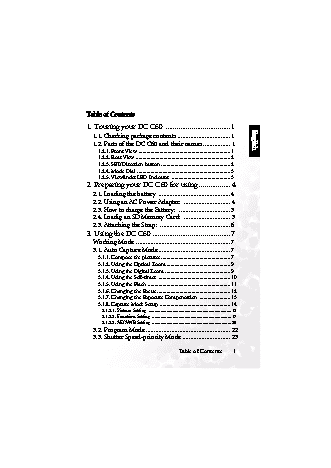
Table of Contents
1. Touring your DC C60 ...................................1
1.1. Checking package contents .................................1
1.2. Parts of the DC C60 and their names .................1  English
1.2.1. Front View  ..................................................................... 1
1.2.2. Rear View ....................................................................... 2
1.2.3. SET/Direction button .................................................... 2
1.2.4. Mode Dial  ...................................................................... 3
1.2.5. Viewfinder LED Indicator  ............................................ 3
2. Preparing your DC C60 for using .................4
2.1. Loading the battery  .............................................4
2.2. Using an AC Power Adapter:  .............................4
2.3. How to charge the Battery:   ................................5
2.4. Loadig an SD Memory Card:  .............................5
2.5. Attaching the Strap:  ............................................6
3. Using the DC C60 ..........................................7
Working Mode ...........................................................7
3.1. Auto Capture Mode.............................................7
3.1.1. Compose the pictures .................................................... 7
3.1.2. Using the Optical Zoom ................................................ 9
3.1.3. Using the Digital Zoom ................................................. 9
3.1.4. Using the Self-timer  ...................................................... 10
3.1.5. Using the Flash  .............................................................. 11
3.1.6. Changing the Focus ....................................................... 12
3.1.7. Changing the Exposure Compensation  ....................... 13
3.1.8. Capture Mode Setup  ..................................................... 14
3.1.8.1. Picture Setting  .....................................................................15
3.1.8.2. Function Setting ..................................................................17
3.1.8.3. AE/AWB Setting ..................................................................20
3.2. Program Mode .....................................................22
3.3. Shutter Speed-priority Mode ..............................23
Table of Contents   I